A complete guide for bloggers, freelancers, and aspiring SEO professionals
Many beginners assume they need to learn programming before starting a career in SEO or blogging. That leads to a common question: Does SEO require coding? The short answer is No — you do not need to become a software developer to build a successful career in SEO. However, learning a few basic programming concepts can sharpen your skills and open more doors over time.
Search engine optimization sounds like a highly technical discipline. Many beginners assume they must learn programming before they can start a career in SEO or blogging — but that assumption holds most people back unnecessarily.
In this guide, we will cover whether coding is truly necessary for SEO, how much technical knowledge actually helps, and what the future of the industry looks like heading into 2030.
Table of Contents
What Is SEO?
Before we explore the coding question, it helps to understand what SEO actually involves. SEO — Search Engine Optimization — is the long-term practice of helping search engines like Google understand, index, and rank your website more favourably in search results.
A typical SEO strategy includes:
- Keyword research
- Content optimization
- Technical website improvements
- Link building
- User experience optimization
- Page speed improvements
The goal, at its core, is simple: help real users find useful, relevant content through search engines.
Does SEO Require Coding?
No — SEO does not require advanced coding skills. Most SEO professionals handle their daily work without writing a single line of complex code.
Many successful bloggers, content writers, affiliate marketers, and SEO executives build entire careers without ever becoming programmers. Modern platforms like WordPress, Shopify, and Wix come with built-in SEO tools that handle most technical needs automatically.
Plugins such as Yoast SEO and Rank Math allow you to optimise titles, meta descriptions, XML sitemaps, and schema markup without touching any code at all. So if you are wondering whether you can learn SEO without a programming background — yes, absolutely.
Why Do People Think SEO Needs Coding?
The confusion is understandable. Web developers and technically-minded SEO professionals often point out that everything Google does — from crawling a page to ranking it — runs on code. That leads many beginners to assume coding is mandatory on their end too.
In reality, only certain technical SEO tasks involve any code at all, such as:
- Editing HTML tags
- Fixing crawl errors
- Improving page speed
- Implementing structured data
- Managing canonical tags
- Configuring robots.txt
But the majority of SEO work — strategy, keyword research, content creation, and link building — has nothing to do with writing code.
Is Coding Necessary For SEO?
Not for most roles. Coding is not required for basic or intermediate SEO work. That said, even a little technical knowledge can set you apart. Here is how coding requirements break down across different SEO roles:
| SEO Role | Coding Required? |
| Content SEO | No |
| Blogging SEO | No |
| Keyword research | No |
| On-page SEO | Minimal |
| Technical SEO | Helpful |
If your goal is blogging, freelancing, affiliate marketing, content marketing, or working as an SEO executive, you can start right now — no coding required. If you eventually want to specialise in technical SEO or enterprise-level work, picking up some basic coding skills will give you a real edge.
Basic Coding For SEO: What You Actually Need
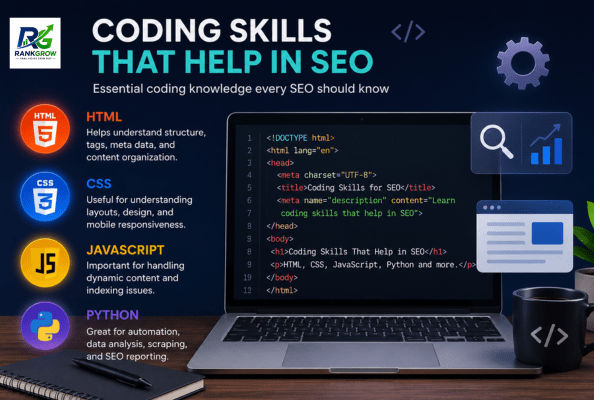
You do not need to learn full-stack development. But a foundational understanding of two or three languages can make you noticeably more effective in technical SEO roles.
1. HTML for SEO
HTML is the single most useful coding language for SEO professionals. Search engines read a page’s HTML structure to understand its content, hierarchy, and relevance. For example:
<h1>Main Heading</h1>
<title>SEO Guide</title>
<meta name=”description” content=”Learn SEO basics”>
Understanding HTML allows you to optimise heading structure, improve meta tags, spot broken elements, and diagnose page issues independently. Even a basic grasp of HTML puts you ahead of many beginners. The MDN Web Docs is an excellent, beginner-friendly starting point for learning HTML fundamentals.
2. CSS (optional)
CSS controls a website’s visual presentation. SEO professionals rarely need to write CSS, but a surface-level understanding can be useful when working alongside developers to fix layout-related issues that affect user experience or Core Web Vitals scores.
3. JavaScript awareness
More websites than ever are built on JavaScript frameworks. Search engines can process JavaScript, but poorly implemented scripts often create crawling and indexing problems. According to Google Search Central, JavaScript rendering directly affects how Googlebot indexes modern websites. You do not need to become a JavaScript developer — but knowing how it influences SEO is genuinely valuable.
Can Bloggers Do SEO Without Coding?
Yes — and many of the most successful bloggers do exactly that.
Content management systems like WordPress handle the technical heavy lifting automatically. SEO plugins, speed optimisation tools, and sitemap generators take care of most tasks that once required coding knowledge. Bloggers who focus on the following consistently outperform those who get distracted by technical complexity:
- Writing high-quality, helpful content
- Targeting the right keywords
- Building strong internal links
- Matching content to search intent
- Delivering a great user experience
- Keeping content up to date
- Earning quality backlinks
A food blogger or travel writer, for instance, spends far more time on research and storytelling than on any kind of technical task — and that is perfectly fine.
Do You Need Coding For SEO Jobs?
For most SEO roles, employers are primarily looking for candidates with strong practical skills:
- Keyword research and content strategy
- On-page and off-page SEO execution
- Google Search Console proficiency
- Analytical and data-driven thinking
- Familiarity with core SEO tools
Day-to-day, tools like Google Search Console, Google Analytics, Ahrefs, SEMrush, and Google Keyword Planner matter far more than any programming language. That said, candidates who can demonstrate some technical understanding often stand out in competitive hiring processes — particularly for mid-level and senior roles.
Benefits Of Learning Basic Coding For SEO
Even if coding is not a requirement, developing a basic technical foundation pays dividends throughout your career. Here is why.
Better technical understanding
Understanding how websites are built helps you spot problems that non-technical SEOs often miss — broken heading hierarchies, missing meta tags, canonical conflicts, indexing errors, and messy URL structures. This kind of insight makes you more self-sufficient and more valuable to any team.
Improved communication with developers
SEO professionals work closely with web developers. Speaking the same language — even at a basic level — means you can explain changes clearly, avoid misunderstandings, and get things implemented faster.
Faster problem solving
Small technical fixes that once required a developer ticket can often be handled directly when you understand basic HTML or CSS. That independence saves time and keeps projects moving.
Better technical SEO opportunities
Technical SEO roles consistently pay higher salaries, largely because fewer people understand this area well. Learning even the basics of coding can open pathways into enterprise SEO, SaaS SEO, website auditing, and SEO consulting — all of which offer strong career growth.
Does Digital Marketing Require Coding?
Digital marketing as a field does not require coding. The vast majority of professionals working in SEO, social media, PPC, email marketing, and content marketing never need to write code in their day-to-day roles. Technical skills become more important in advanced positions involving website tracking, marketing automation, analytics engineering, and conversion rate optimisation — but even then, dedicated tools often handle the complexity.
What Is The Future Of SEO In 2030?
The concern that AI will replace SEO professionals is understandable — but largely overstated. SEO is evolving rapidly, not disappearing. Search engines will always need high-quality, trustworthy content, and human expertise remains at the centre of that equation.
According to Google Search Central, helpful content created genuinely for users continues to be a core ranking factor. Here is what the landscape is likely to look like by 2030:
AI changes workflows
AI tools will assist with research, clustering, and drafting — but E-E-A-T and human judgement remain essential.
Technical SEO grows
Core Web Vitals, structured data, and site architecture will carry even more weight as sites grow more complex.
Intent over keywords
Google will continue moving toward understanding what users actually want, rewarding depth and expertise over keyword repetition.
Voice and AI search
Content will need to be conversational, direct, and genuinely useful as voice and AI-generated search experiences expand.
Should You Learn Coding For SEO?
Here is a practical recommendation.
If you are a beginner
Start with the fundamentals: keyword research, on-page SEO, content writing, and search intent. Do not let the fear of coding delay your progress — you do not need it to begin, and you can always build technical skills later.
After you have the basics down
Gradually introduce HTML basics, a little CSS awareness, and core technical SEO concepts. This combination creates a well-rounded skill set that positions you for stronger, long-term career growth.
Best Resources To Learn SEO Without Coding
These are some of the most trusted, beginner-friendly places to start:
- Google Search Central Documentation
- Moz Beginner’s Guide to SEO
- Ahrefs SEO Blog
- Semrush Academy
- HubSpot SEO Training
Final Thoughts
Most people can start learning SEO today — and build a genuinely successful career — without writing a single line of code. Learning basic coding gives you an edge, especially as your career grows into more technical territory. Combine strong SEO fundamentals with a willingness to pick up technical knowledge over time, and you have everything you need for a long-term career in digital marketing.
Frequently Asked Questions
Clear, beginner-friendly answers to the most common questions about SEO and coding.
Q1. Does SEO require coding? No. Most SEO tasks like keyword research, content optimization, and link building require no coding knowledge at all.
Q2. Can I learn SEO as a complete beginner with no technical background? Absolutely. Platforms like WordPress, Shopify, and Wix, combined with plugins like Yoast SEO and Rank Math, make SEO accessible to anyone without coding skills.
Q3. What basic coding skills are helpful for SEO? A basic understanding of HTML (headings, meta tags, title tags) is the most useful. Awareness of how JavaScript affects crawling is a bonus, but not mandatory.
Q4. Do SEO jobs require coding? Most entry-level and intermediate SEO roles do not. Employers primarily look for skills in keyword research, content optimization, Google Analytics, and tools like Ahrefs and SEMrush.
Q5. Is technical SEO different from regular SEO? Yes. Technical SEO involves tasks like fixing crawl errors, improving page speed, and implementing structured data — areas where basic coding knowledge is helpful but still not strictly required.
Q6. Will AI replace SEO professionals? No. AI is changing SEO workflows, but human expertise, originality, and trustworthiness (E-E-A-T) remain core ranking factors that machines cannot fully replicate.
Q7. What is the future of SEO by 2030? SEO will evolve to focus more on user intent, voice search, Core Web Vitals, and AI-assisted content strategies — but quality content and technical optimization will remain essential.
Q8. Where can beginners learn SEO for free? Great starting points include Google Search Central, Moz’s Beginner’s Guide to SEO, Ahrefs Blog, Semrush Academy, and HubSpot’s SEO training.

Shivam Pandey is an SEO Specialist and Digital Marketing professional passionate about helping businesses improve their online visibility. He shares practical insights on SEO, content marketing, digital marketing strategies, and the latest industry trends to help marketers and businesses grow online.