If you’ve recently started learning Search Engine Optimization (SEO), you’ve probably come across terms like DA (Domain Authority) and PA (Page Authority). Many SEO tools display these scores, and marketers often use them to evaluate a website’s strength.
But what exactly are DA and PA? Are they Google ranking factors? Should you focus on increasing them?
In this beginner-friendly guide, you’ll learn everything you need to know about Domain Authority (DA) and Page Authority (PA), how they work, why they matter, and the best practices to improve them.
Table of Contents
Quick Answer
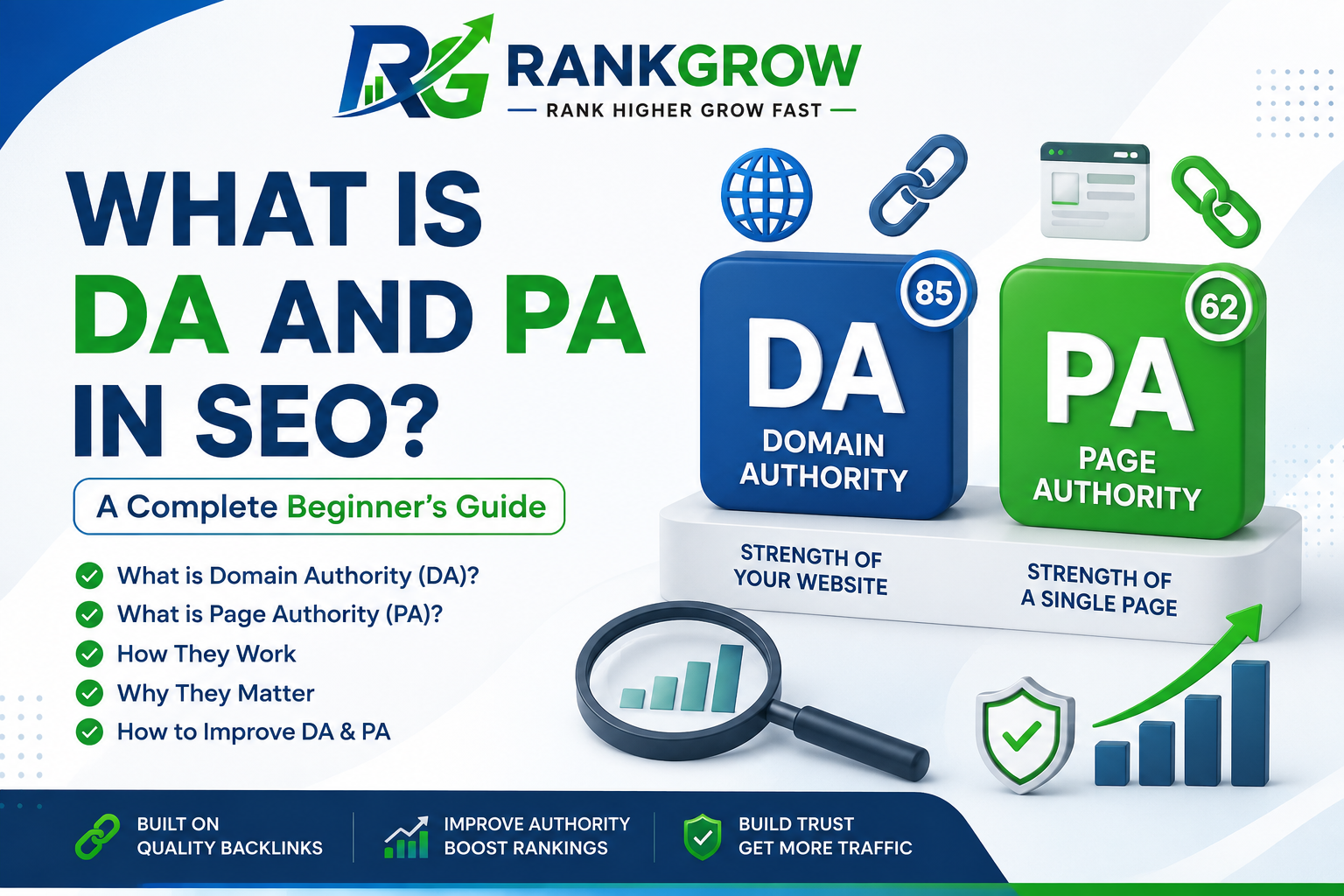
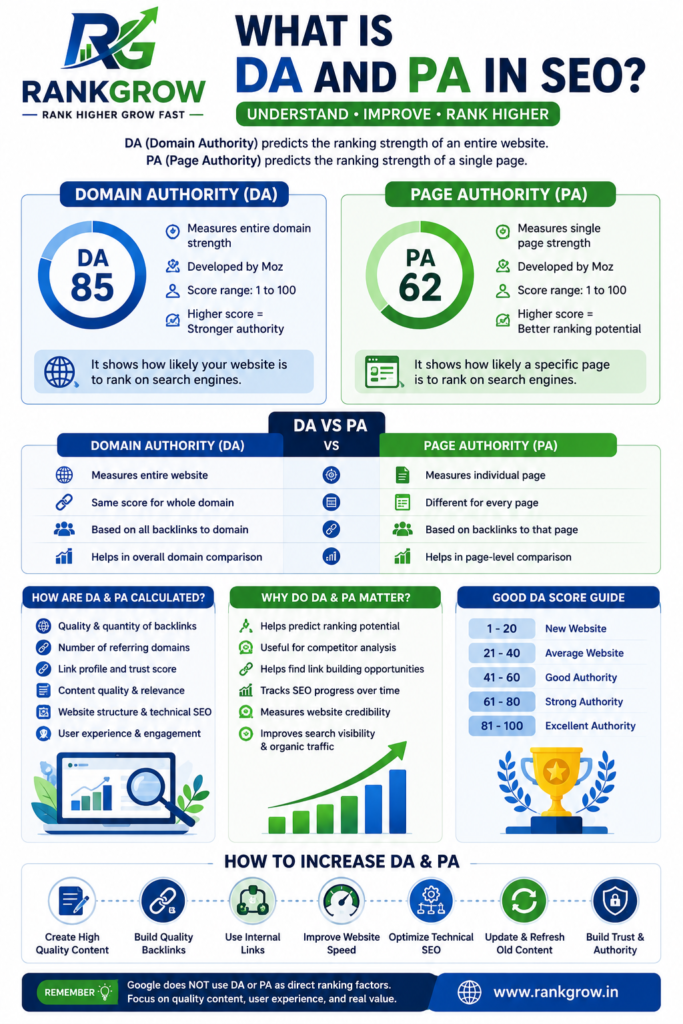
DA (Domain Authority) is a score developed by Moz that predicts how likely an entire website is to rank in search engines.
PA (Page Authority) measures the ranking strength of a single webpage instead of the whole website.
Both scores range from 1 to 100, where higher scores generally indicate stronger authority.
Important: Google does not use Domain Authority or Page Authority as direct ranking factors.
What Is Domain Authority (DA)?
Domain Authority (DA) is an SEO metric created by Moz to estimate the overall authority and ranking potential of an entire domain.
Think of your website like a university.
- The university’s overall reputation represents Domain Authority.
- Every department inside the university has its own reputation, which is similar to Page Authority.
A website with a higher DA usually has:
- High-quality backlinks
- Strong content
- Good website structure
- Better trust signals
- Consistent SEO performance
Example
Imagine two websites:
| Website | Domain Authority |
|---|---|
| Website A | DA 82 |
| Website B | DA 18 |
If both publish articles on the same topic with similar quality, Website A generally has a better chance of ranking because it has stronger overall authority.
However, quality content is still essential.
What Is Page Authority (PA)?
Page Authority (PA) measures the ranking potential of a single webpage rather than the entire website.
Every page on your website can have a different PA score.
For example:
| Page | PA |
|---|---|
| Homepage | 70 |
| Blog Post | 45 |
| Service Page | 52 |
| Contact Page | 28 |
A webpage with stronger backlinks and better optimization usually has a higher Page Authority.
DA vs PA
| Domain Authority | Page Authority |
|---|---|
| Measures entire website | Measures individual page |
| Predicts domain strength | Predicts page strength |
| Same score across website | Different for every page |
| Influenced by overall backlinks | Influenced by page-specific backlinks |
| Helps evaluate overall authority | Helps compare specific pages |
Why Are DA and PA Important?
Although Google doesn’t directly use DA or PA, these metrics help SEO professionals evaluate websites.
Benefits include:
- Measuring website credibility
- Comparing competitors
- Finding backlink opportunities
- Tracking SEO progress
- Evaluating guest posting websites
- Estimating ranking potential
For example, if you’re choosing between two guest blogging websites, you’ll often prefer the one with higher authority—provided it is relevant and trustworthy.
Does Google Use Domain Authority?
This is one of the biggest myths in SEO.
The answer is:
No.
Google has repeatedly stated that it does not use Moz’s Domain Authority or Page Authority scores as ranking signals.
Instead, Google evaluates websites using hundreds of ranking signals, including:
- Content quality
- Helpful information
- Search intent
- User experience
- Backlinks
- Internal linking
- Page speed
- Mobile friendliness
- Technical SEO
- Website security
DA is simply a third-party metric designed to estimate authority.
How Is Domain Authority Calculated?
Moz calculates Domain Authority using machine learning and multiple SEO factors.
Some important factors include:
1. Backlink Quality
Links from trusted websites carry more value than links from low-quality or spammy websites.
Example:
A backlink from a well-known industry blog is generally more valuable than dozens of links from unrelated directories.
2. Number of Referring Domains
Getting backlinks from many unique websites is usually better than getting many links from the same website.
Example:
- 100 backlinks from 1 website ❌
- 100 backlinks from 100 websites ✅
3. Link Profile
A natural backlink profile includes links from:
- Blogs
- News websites
- Educational websites
- Business directories
- Industry resources
A diverse link profile signals broader recognition.
4. Website Trust
Websites with consistent, high-quality content and natural backlinks tend to build stronger trust over time.
5. Overall Website Quality
Factors such as technical SEO, clean site structure, and user-friendly design contribute to a stronger website that is more likely to attract quality links.
What Is a Good Domain Authority Score?
There isn’t a universal “good” DA score because it depends on your industry and competitors.
Here’s a general guideline:
| DA Score | Meaning |
|---|---|
| 1–20 | New website |
| 21–40 | Growing website |
| 41–60 | Strong authority |
| 61–80 | Highly authoritative |
| 81–100 | Top industry websites |
Rather than chasing a specific number, compare your DA with websites competing for the same keywords.
How to Increase Domain Authority
Improving DA takes time and consistent SEO efforts. Here are some effective strategies:
1. Create High-Quality Content
Publish helpful, original, and in-depth content that answers users’ questions.
Content that provides real value naturally attracts backlinks and shares.
2. Earn High-Quality Backlinks
Focus on obtaining links from relevant and reputable websites through:
- Guest posting
- Digital PR
- Resource pages
- Industry partnerships
- Original research
- Useful guides
Avoid buying backlinks or participating in link schemes.
3. Improve Technical SEO
Ensure your website is technically sound by:
- Fixing broken links
- Using HTTPS
- Improving page speed
- Creating an XML sitemap
- Optimizing crawlability and indexing
- Making the site mobile-friendly
4. Strengthen Internal Linking
Internal links help search engines understand your website structure and distribute authority between pages.
For example, link your beginner SEO guide to articles about keyword research, on-page SEO, and technical SEO.
5. Remove Toxic Backlinks
Monitor your backlink profile and address harmful or spammy links if they become an issue.
6. Update Old Content
Refreshing outdated articles with current information, better examples, and improved formatting can increase their usefulness and attract new backlinks.
How to Improve Page Authority
Improving PA focuses on strengthening an individual page.
Best practices include:
- Optimize the title tag and headings
- Add relevant keywords naturally
- Improve content depth
- Include helpful visuals
- Build backlinks directly to the page
- Add internal links from important pages
- Improve user experience
- Increase page loading speed
- Keep the content updated
Best Tools to Check DA and PA
Several SEO tools provide authority metrics:
- Moz Link Explorer – Creator of Domain Authority and Page Authority.
- Ahrefs – Uses Domain Rating (DR) and URL Rating (UR).
- Semrush – Offers an Authority Score based on multiple factors.
- Ubersuggest – Provides domain authority insights and backlink data.
- Small SEO Tools – Includes a free DA and PA checker for basic analysis.
Remember that each tool uses its own algorithm, so scores may differ.
Common Mistakes to Avoid
Many beginners make these mistakes:
- Focusing only on increasing DA instead of improving content.
- Buying low-quality backlinks.
- Ignoring technical SEO issues.
- Publishing thin or duplicate content.
- Neglecting internal linking.
- Expecting quick results—authority grows gradually.
DA vs Google’s Ranking Factors
| Domain Authority | Google Ranking Factors |
|---|---|
| Third-party metric | Used by Google |
| Developed by Moz | Google’s own algorithms |
| Predicts ranking ability | Determines actual rankings |
| Helpful for comparison | Directly influences search results |
Best Practices for Building Website Authority
To build long-term authority:
- Publish helpful, original content regularly.
- Earn backlinks from trusted and relevant websites.
- Optimize technical SEO.
- Improve website performance and page speed.
- Build a logical internal linking structure.
- Focus on user experience.
- Demonstrate expertise, experience, authoritativeness, and trustworthiness (E-E-A-T).
- Keep content accurate and up to date.
Frequently Asked Questions
What is DA and PA in SEO?
DA (Domain Authority) measures the strength of an entire website, while PA (Page Authority) measures the strength of a single webpage. Both are metrics developed by Moz.
Is Domain Authority important?
Yes, Domain Authority is useful for comparing websites and tracking SEO progress, but it is not a direct Google ranking factor.
Does Google use Domain Authority?
No. Google has confirmed that it does not use Moz’s Domain Authority score in its ranking algorithm.
What is a good Domain Authority score?
A score above 40 is generally considered strong for many websites, but the ideal score depends on your niche and competitors.
How long does it take to increase Domain Authority?
There is no fixed timeline. With consistent content creation, quality backlinks, and technical SEO improvements, noticeable growth often takes several months.
Which is more important: DA or PA?
Both matter, but they serve different purposes. DA reflects the overall authority of a website, while PA indicates the ranking potential of an individual page.
Conclusion
Understanding what is DA and PA in SEO helps you evaluate the authority and growth of your website. While Domain Authority and Page Authority are valuable metrics for benchmarking and competitive analysis, they should not become your primary SEO goal.
Instead, focus on creating high-quality content, earning relevant backlinks, improving technical SEO, strengthening internal linking, and delivering a great user experience. Over time, these efforts can improve both your website’s authority metrics and its ability to rank well in search results.
Ultimately, the best way to build authority is to create a website that users trust and find genuinely helpful.

Shivam Pandey is an SEO Specialist and Digital Marketing professional passionate about helping businesses improve their online visibility. He shares practical insights on SEO, content marketing, digital marketing strategies, and the latest industry trends to help marketers and businesses grow online.