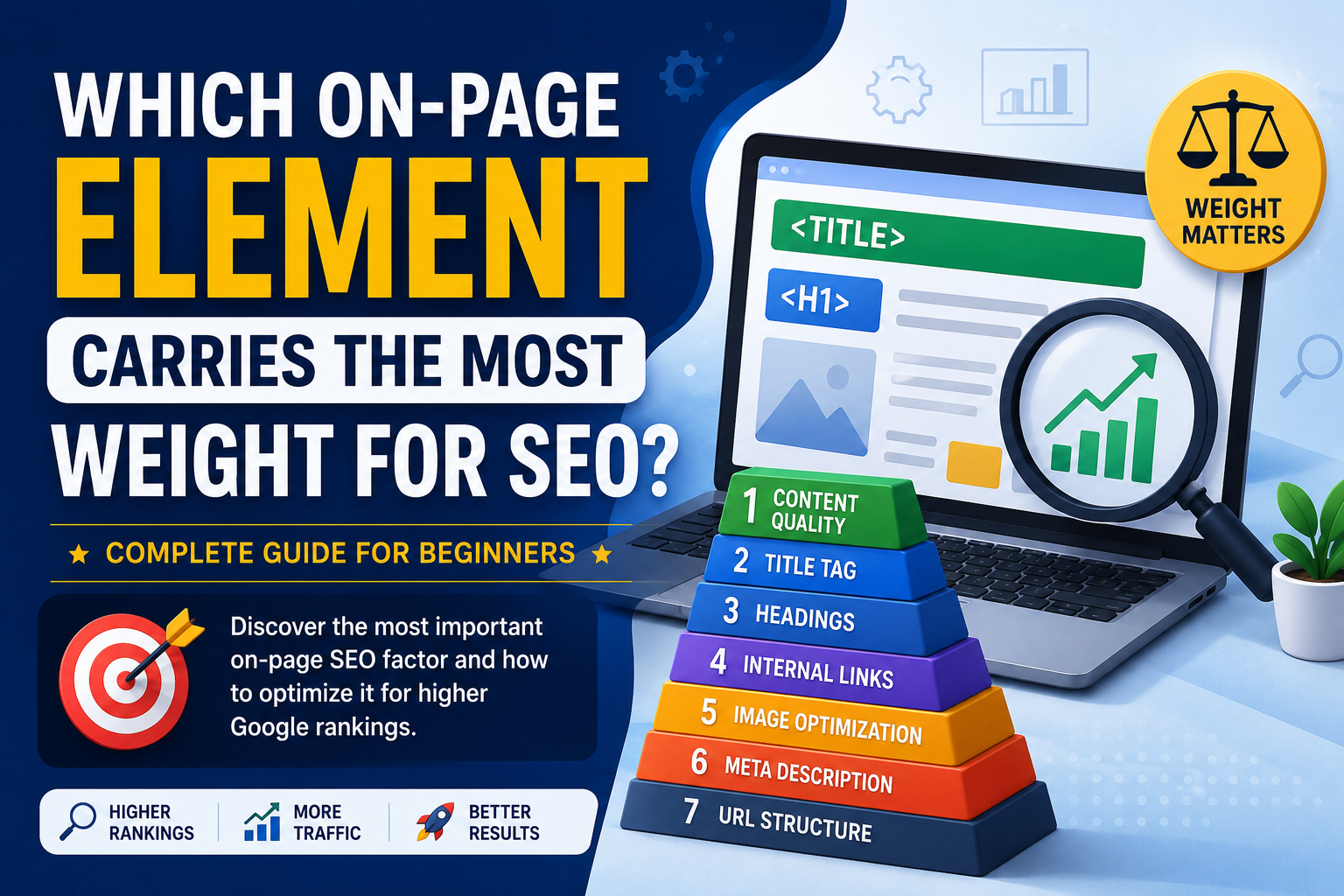
which on-page element carries the most weight for SEO? , you’re not alone. Many beginners believe it’s the title tag, while others think it’s keywords or backlinks. The truth is that several on-page SEO elements work together, but one stands out more than the others.
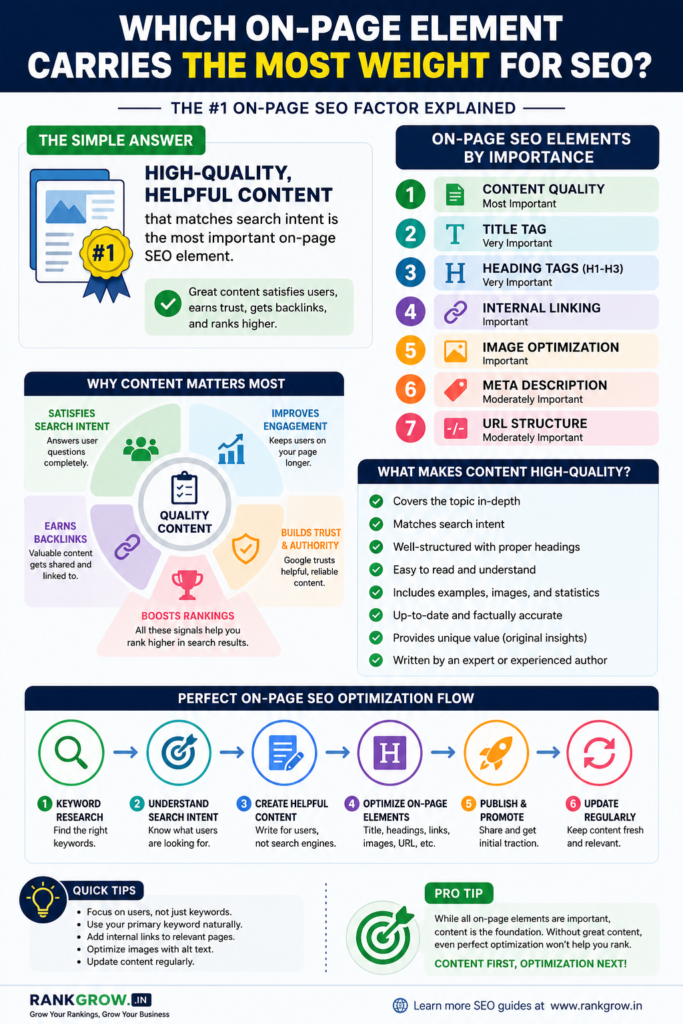
The page content—especially high-quality, search-intent-focused content—is the most important on-page SEO element. However, title tags, headings, internal links, URLs, images, and meta descriptions also play essential supporting roles.
In this guide, you’ll learn exactly how Google evaluates on-page elements, which factors matter most, and how to optimize your pages for higher rankings in 2026.
Table of Contents
Featured Snippet Answer
Which on-page element carries the most weight for SEO?
The most important on-page SEO element is high-quality content that satisfies user search intent. While title tags help search engines understand the page topic, comprehensive and valuable content provides the strongest ranking signals. Supporting elements like H1 tags, internal links, optimized URLs, image alt text, and schema markup further improve visibility and rankings.
Why On-Page SEO Matters
On-page SEO refers to everything you optimize inside your website to help search engines understand your content and improve user experience.
It includes:
- Content quality
- Title tags
- Meta descriptions
- Heading tags
- URLs
- Images
- Internal links
- Schema markup
- Keyword optimization
- Page speed
When these elements are properly optimized, Google can better understand your page and determine whether it deserves to rank.
The Most Important On-Page SEO Element: High-Quality Content
That’s why content carries the greatest weight.
Your content should:
- Solve the user’s problem
- Match search intent
- Be original
- Be comprehensive
- Include examples
- Use simple language
- Stay updated
Google’s Helpful Content System rewards content created for people rather than search engines.
Example
If someone searches:
“Which on page element carries the most weight for SEO 2026?“
A high-quality article should explain:
- The most important element
- Why it matters
- Supporting ranking factors
- Best optimization practices
- Common mistakes
- FAQs
Instead of giving only a one-line answer.
Importance of Search Intent
Search intent means understanding why someone searched for a keywords.
Google ranks pages that satisfy user intent.
There are four common types:
Informational
Example:
Navigational
Example:
- Google Search Console login
Commercial
Example:
- Best SEO tools
Transactional
Example:
- Buy SEO services
Matching search intent is often more important than simply adding keywords repeatedly.
Other Important On-Page SEO Elements
Although content is the strongest ranking factor, these elements also significantly influence rankings.
1. Title Tag
The title tag tells Google what your page is about.
Example:
Which On-Page Element Carries the Most Weight for SEO? Complete Guide
Best Practices
- Include primary keyword
- Keep under 60 characters
- Make it compelling
- Avoid duplicate titles
2. H1 Heading
The H1 confirms the page topic.
Usually:
- One H1 per page
- Include primary keyword naturally
Example:
Which On-Page Element Carries the Most Weight for SEO?
3. Meta Description
Meta descriptions don’t directly improve rankings.
However, they increase click-through rate (CTR), which can indirectly improve performance.
Example:
Learn which on-page SEO element has the biggest impact on rankings and how to optimize your website for better visibility.
4. URL Structure
Good URLs are:
- Short
- Descriptive
- Keyword-rich
- Easy to read
Good:
example.com/which-on-page-element-carries-the-most-weight-for-seoBad:
example.com/post?id=245675. Heading Tags (H2-H6)
Proper headings improve:
- Readability
- User experience
- SEO structure
Example:
H2 → Importance of Content
H3 → Content Depth
H3 → Content Freshness
6. Internal Linking
Internal links help Google:
- Discover pages
- Understand relationships
- Pass authority
Example:
If your website has articles on:
- What is SEO?
- Keyword Research
- Technical SEO
- On-Page SEO Checklist
Link them naturally.
7. Image Optimization
Images improve engagement.
Optimize them by:
- Compressing size
- Using descriptive file names
- Adding ALT text
- Using WebP format
Example ALT Text:
On-page SEO ranking factors diagram8. Keyword Placement
Instead of stuffing keywords everywhere, place them naturally in:
- Title
- H1
- First paragraph
- H2 headings
- URL
- Image ALT text
- Conclusion
Google understands synonyms and related terms.
9. Content Freshness
Regular updates signal that your content remains relevant to your niche.
Update:
- Statistics
- Examples
- Screenshots
- SEO practices
- Broken links
10. User Experience (UX)
Google values pages that are easy to use.
Improve:
- Mobile responsiveness
- Fast loading speed
- Readable fonts
- Clear navigation
- White space
- Accessibility
Semantic Keywords to Use Naturally
Include related keywords to your niche throughout your article instead of repeating the exact phrase excessively:
- On-page SEO
- SEO ranking factors
- Google ranking algorithm
- Title tag optimization
- SEO content
- Search intent
- Internal linking
- Keyword optimization
- Meta tags
- H1 tag
- Heading structure
- Content quality
- User experience
- Technical SEO
- Website optimization
- Organic traffic
- Search engine optimization
- SEO best practices
- Content relevance
- Core Web Vitals
How Google Evaluates On-Page SEO
Google considers hundreds of signals.
For on-page SEO, it evaluates:
| Ranking Factors | Importance |
|---|---|
| Content Quality with images | ⭐⭐⭐⭐⭐ |
| Search Intent | ⭐⭐⭐⭐⭐ |
| Title Tag | ⭐⭐⭐⭐ |
| Internal Links | ⭐⭐⭐⭐ |
| Heading Structure | ⭐⭐⭐⭐ |
| URL | ⭐⭐⭐ |
| Meta Description | ⭐⭐ |
| Keyword Placement | ⭐⭐⭐⭐ |
Common On-Page SEO Mistakes
Avoid these mistakes:
Keyword Stuffing
Bad:
SEO SEO SEO SEO SEO SEO
Good:
Write naturally for users.
Thin Content
Publishing 300-word articles rarely satisfies competitive search intent.
Aim for comprehensive, helpful content.
Duplicate Titles
Each page should have a unique title.
Missing Internal Links
Connect related articles to improve crawlability and user navigation.
Ignoring Mobile Users
Most searches happen on mobile devices.
Ensure your site is responsive and loads quickly.
On-Page SEO Checklist
Before publishing any article, confirm that you have:
- Primary keyword in title
- Keyword in H1
- SEO-friendly URL
- Compelling meta description
- Helpful introduction
- Clear H2 and H3 headings
- Internal links
- External authority links
- Optimized images
- Mobile-friendly design
- Fast loading speed
- Updated information
- Strong conclusion
- Call-to-action
Internal Linking Suggestions
To strengthen topical authority, link this article to other relevant pages on your website, such as:
- What Is SEO and Why Is It Important?
- On-Page SEO Checklist for Beginners
- Technical SEO vs On-Page SEO
- Keyword Research Guide
- How to Add Keywords to a Website
- Types of SEO Explained
- SEO Audit Checklist
- Beginner’s Guide to Google Search Console
These contextual links help search engines understand your content relationships and keep users engaged longer.
External Authority Resources
For trustworthy information and official guidance, reference:
- Google Search Central Documentation
- Google Search Quality Evaluator Guidelines
- Google PageSpeed Insights
- Google Search Console Help Center
Linking to authoritative sources can improve user trust and provide additional value.
Frequently Asked Questions (FAQs)
What is the most important on-page SEO factor?
High-quality, relevant content that satisfies search intent is the most important on-page SEO factor.
Is the title tag the most important SEO element?
The title tag is highly important because it helps search engines understand your page, but content has a greater overall impact on rankings.
Do meta descriptions affect rankings?
Meta descriptions are not a direct ranking factor, but they can improve click-through rates, which may indirectly benefit SEO performance.
How many keywords should I use?
Focus on one primary keyword and naturally incorporate related semantic keywords. Avoid keyword stuffing.
Does internal linking help SEO?
Yes. Internal links improve crawlability, distribute page authority, and help users discover related content.
How often should I update SEO content?
Review important pages every 6–12 months or whenever significant changes occur in your industry to keep content fresh and accurate.
Conclusion
So, which on-page element carries the most weight for SEO? The answer is high-quality content that matches user search intent. While title tags, headings, internal links, optimized URLs, and images all contribute to better rankings, none of them can replace content that genuinely helps users.
To achieve long-term SEO success, focus on creating valuable, well-structured, and easy-to-read articles. Combine that with smart keyword placement, strong internal linking, optimized page experience, and regular content updates. This holistic approach not only improves search rankings but also builds trust with your audience and increases organic traffic over time.
Ready to grow your website? Start by auditing one page today, improve its content quality, optimize every important on-page element, and track your results in Google Search Console. Consistent improvements can lead to lasting SEO success.

Shivam Pandey is an SEO Specialist and Digital Marketing professional passionate about helping businesses improve their online visibility. He shares practical insights on SEO, content marketing, digital marketing strategies, and the latest industry trends to help marketers and businesses grow online.