
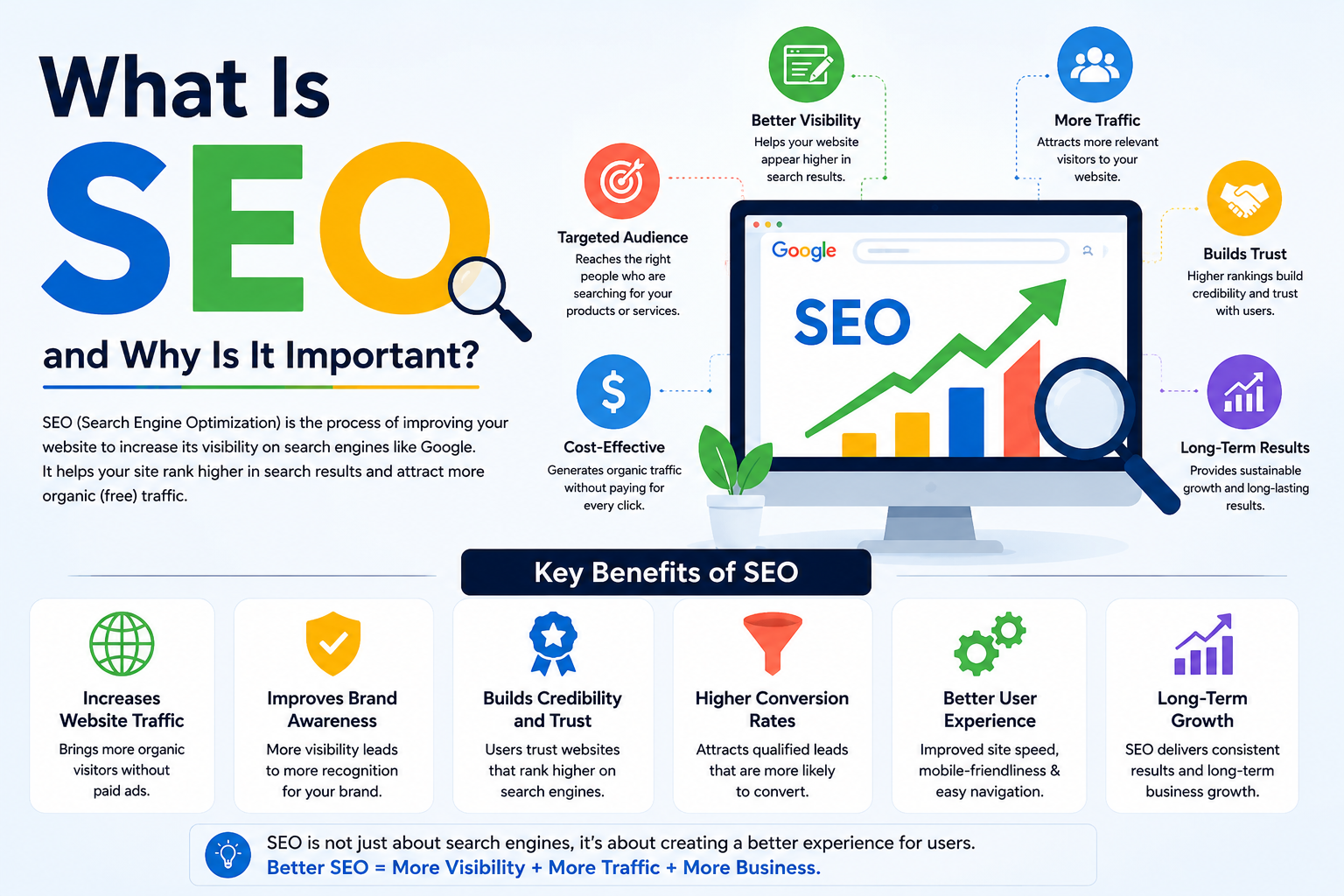
In this beginner-friendly guide, you will learn what is SEO and why is it important, how it works, its different types, benefits, and the best practices to help your website rank higher in search engines.
Whether you are a blogger, business owner, digital marketer, freelancer, or ecommerce store owner, SEO is one of the most powerful digital marketing strategies for attracting free, targeted traffic to your website.
Unlike paid advertising, SEO helps your website earn visibility organically.
When done correctly, it can generate leads, increase brand awareness, improve user experience, and drive long-term business growth.
Learn more about – https://rankgrow.in/search-engine-optimization-presentation-2026/
Table of Contents
What Is SEO?
SEO (Search Engine Optimization) is the process of optimizing a website to improve its visibility in search engine results pages (SERPs).
The goal is to help search engines understand your content so it can appear when users search for relevant topics.
Instead of paying for every click through ads, SEO focuses on earning organic traffic by creating valuable content, optimizing website structure, and building authority.
Featured Snippet Answer
SEO (Search Engine Optimization) is the practice of improving a website’s content, technical performance, and authority so it ranks higher in search engine results and attracts more organic traffic.
How Does SEO Work?
Search engines like Google use automated bots called crawlers to discover webpages across the internet.
The SEO process generally works in four stages:
1.Crawling
Google bots visit websites and discover new pages.
2.Indexing
After crawling, Google stores your pages in its search index.
3.Understanding Content
Google analyzes your content, keywords, images, page structure, and overall quality to understand the topic.
4.Ranking
When someone searches for a related query, Google ranks pages based on hundreds of ranking signals such as relevance, content quality, user experience, page speed, backlinks, and authority.
Why Is SEO Important?
SEO is important because it helps your website become visible to people who are already searching for information, products, or services like yours.
Without SEO, even the best website may struggle to receive visitors from search engines.
Benefits of SEO
Increases Organic Traffic.
SEO helps attract visitors without paying for advertisements, making it a cost-effective marketing strategy.
Builds Trust and Credibility.
Users tend to trust websites that appear on the first page of Google because they perceive them as more reliable and authoritative.
Improves User Experience
Modern SEO emphasizes fast-loading pages, mobile-friendly design, clear navigation, and high-quality content, all of which enhance the user experience.
Generates high-quality leads.
SEO targets users with specific search intent, meaning the traffic you receive is more likely to convert into customers or subscribers.
Provides Long-Term Results
Unlike paid campaigns that stop when the budget ends, SEO can continue generating traffic for months or even years with regular updates and optimization.
Delivers better ROI.
Businesses often achieve a strong return on investment because SEO brings consistent organic traffic without paying for every click.
Types of SEO
A successful SEO strategy includes several key areas.
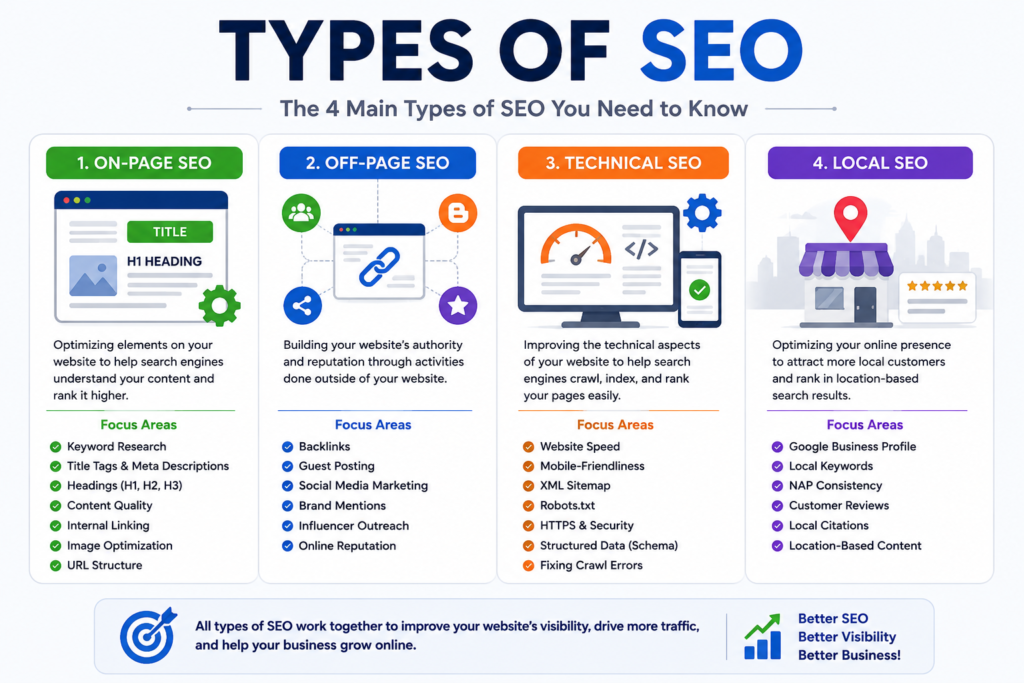
1.On-Page SEO
On-page SEO involves optimizing elements directly on your website, such as:
- Title tags
- Meta descriptions
- Headings (H1–H3)
- Keyword placement
- Internal linking
- Image optimization
- Content quality
- URL structure
2.Off-Page SEO
Off-page SEO focuses on improving your website’s authority through activities outside your site, including:
- High-quality backlinks
- Guest posting
- Brand mentions
- Social media sharing
- Digital PR
3.Technical SEO
Technical SEO ensures that search engines can crawl and index your website efficiently.
Key aspects include:
- Fast page speed
- Mobile responsiveness
- HTTPS security
- XML sitemap
- Robots.txt
- Structured data (Schema)
- Core Web Vitals
- Fixing crawl errors
4.Local SEO
helps businesses appear in local search results in Google Maps..
It involves optimizing your Google Business Profile, collecting reviews, and maintaining consistent business information across directories.
Key Components of an Effective SEO Strategy
To succeed with SEO, focus on these essential elements:
Keyword Research
Find the terms your audience searches for using tools like Google Keyword Planner, Google Search Console, Ahrefs, or SEMrush.
High-Quality Content
Create original, helpful, and well-structured content that answers users’ questions satisfies search intent.
Internal Linking:
Connect related pages on your website to help users navigate and to distribute page authority.
Suggested Internal Links:
- Beginner’s Guide to Keyword Research
- Technical SEO Checklist
- On-Page SEO Guide
- Off-Page SEO Strategies
- How to Add Keywords to Your Website
User Experience (UX)
A clean layout, readable fonts, intuitive navigation, and fast-loading pages improve engagement and support SEO performance.
Semantic Keywords
Include related terms naturally throughout your content, such as:
- Search Engine Optimization
- Organic traffic
- Google ranking
- SEO strategy
- Website optimization
- Keyword research
- On-page SEO
- Off-page SEO
- Technical SEO
- Local SEO
- Search intent
- Meta tags
- Backlinks
- Core Web Vitals
- Content marketing
These terms help search engines better understand your topic without keyword stuffing.
External Authority Resources
For reliable SEO guidance, refer to:
- Google Search Central
- Google Search Console Help
- Google Analytics Help Center
- Page Speed Insights
- Google SEO Starter Guide
These official resources provide best practices directly from Google.
Common SEO Mistakes
Common SEO Mistakes to Avoid
Keyword stuffing
Publishing thin or duplicate content
Ignoring mobile optimization
Slow-loading pages
Missing meta titles and descriptions
Broken internal links
Poor website navigation
Neglecting image optimization
Buying low-quality backlinks
Failing to update outdated content
Frequently Asked Questions (FAQs)
What is SEO in simple words?
SEO is the process of improving a website so it appears higher in search engine results and attracts more organic visitors.
Why is SEO important for businesses?
SEO helps businesses reach potential customers, increase website traffic, build trust, and generate leads without relying solely on paid advertising.
Is SEO free?
You don’t pay search engines for organic rankings, but effective SEO requires time, expertise, quality content, and sometimes investment in tools.
What is the difference between SEO & SEM?
SEO focuses on earning organic traffic, while SEM (Search Engine Marketing) includes paid advertising such as Google Ads.
Can beginners learn SEO?
Yes. With consistent practice, learning resources, and real-world application, beginners can develop strong SEO skills over time.
Conclusion
SEO is much more than adding keywords to a webpage. It is a comprehensive strategy that combines high-quality content, technical optimization, user experience, and authority building to help websites rank higher in search results.
Whether you’re running a personal blog, an online store, or a business website, investing in SEO can deliver sustainable growth, attract qualified visitors, and strengthen your online presence. As search engines continue to evolve, focusing on helpful content and user satisfaction remains the foundation of long-term SEO success.
Ready to improve your website’s rankings? Start by optimizing one page today, conduct thorough keyword research, publish valuable content regularly, and monitor your progress using Google Search Console. Consistent SEO efforts will help you attract more organic traffic and grow your online presence over time.

Shivam Pandey is an SEO Specialist and Digital Marketing professional passionate about helping businesses improve their online visibility. He shares practical insights on SEO, content marketing, digital marketing strategies, and the latest industry trends to help marketers and businesses grow online.