
Images are no longer used only to make a website look attractive. They can also support search visibility, brand awareness, referral traffic, content distribution, and overall SEO performance when used correctly.
One often-overlooked off-page SEO technique is image submission in SEO. It involves submitting or sharing relevant images on image-sharing, visual-content, social, bookmarking, portfolio, and other third-party platforms to increase the visibility of your visual content and potentially generate referral traffic and brand exposure.
However, image submission should not be confused with simply uploading an image anywhere and expecting backlinks or rankings. Modern SEO requires a more strategic approach. The image should be relevant, useful, properly optimized, and published on platforms where your target audience is actually present.
In this guide, you will learn what image submission in SEO means, how image submission works, its benefits, how to optimize images before submission, where it fits into an off-page SEO strategy, common mistakes to avoid, and how to use it as part of a broader topical authority strategy.
Table of Contents
What Is Image Submission in SEO?
Image submission in SEO is an off-page SEO and content promotion technique where optimized, relevant images are submitted or shared on third-party visual-content platforms to increase online visibility, attract referral traffic, promote a brand, and potentially earn links or mentions.
The images may include:
- Infographics
- Charts and graphs
- Product images
- Original photographs
- Illustrations
- Data visualizations
- Memes
- Branded graphics
- Educational images
- Step-by-step visuals
- Social media graphics
- Blog featured images
For example, suppose you publish an article about “On-Page SEO Checklist.” Instead of publishing only the article, you could create a useful infographic summarizing the checklist.
You can then publish or promote that infographic through appropriate visual-content platforms while directing interested users to the original article on your website.
The objective is not simply to create hundreds of links. Instead, the goal is to distribute useful visual content across relevant channels and create additional opportunities for people to discover your website.
Simple Definition of Image Submission
Image submission means sharing optimized and relevant images on suitable external platforms to improve visibility, brand exposure, referral traffic, and content discovery.
Why Is Image Submission Important in SEO?
Search engines increasingly understand visual content and use images in multiple search experiences.
Google explains that images can appear across Google Images, standard search results, Discover, and other search experiences. Google also recommends helping search engines discover images and optimizing the pages where those images appear. (Google for Developers)
This makes image optimization valuable for both on-page SEO and off-page content promotion.
Image submission can support SEO in several ways.
1. It Can Increase Brand Visibility
Visual content can introduce your business to users who may never have discovered your website through traditional web search.
For example, a digital marketing website could create:
- SEO checklists
- Keyword research infographics
- Technical SEO diagrams
- Link-building graphics
- SEO statistics charts
When these visuals are distributed through relevant platforms, more people can encounter the brand.
2. It Can Generate Referral Traffic
A properly optimized image submission may contain a link or reference to your website, depending on the platform’s policies.
If users find the image useful and click through to your website, you can receive referral traffic.
Importantly, referral traffic and content discovery are valuable even when a platform does not provide a traditional followed backlink.
3. It Supports Content Distribution
Creating excellent content is only half the job.
You also need to distribute it.
An infographic can become:
- A blog visual
- A Pinterest-style graphic
- A social media post
- A presentation visual
- An educational image
- A downloadable resource
Therefore, one original visual can support multiple content formats.
4. It Can Support Link Earning
Useful visual content has the potential to earn organic links.
For example, imagine you create an original infographic containing research about SEO trends. Another blogger may discover it, reference your statistics, and link to the original source.
This is much stronger than blindly submitting the same image to hundreds of low-quality websites.
5. It Can Strengthen Topical Authority
This is especially important if your objective is to build topical authority.
Suppose your website focuses on SEO.
You could create visual resources around:
- On-page SEO
- Off-page SEO
- Technical SEO
- Local SEO
- Keyword research
- Link building
- Image SEO
- Content SEO
- SEO analytics
- Search intent
These visuals reinforce your website’s overall topical coverage.
Image Submission vs Image SEO: What Is the Difference?
These two terms sound similar, but they are not exactly the same.
| Image Submission | Image SEO |
|---|---|
| Primarily focuses on external distribution | Primarily focuses on search optimization |
| Often associated with off-page SEO | Mostly associated with on-page/technical SEO |
| Uses third-party platforms | Optimizes images on your website |
| Can generate referral traffic | Can improve image discoverability |
| Can support brand promotion | Improves user experience and accessibility |
| May support link acquisition | Helps search engines understand images |
Image SEO includes:
- Descriptive image filenames
- Relevant alt text
- Image compression
- Responsive images
- Appropriate formats
- Captions where useful
- Contextual placement
- Structured data where appropriate
- Image sitemaps
- Fast loading
Image submission includes:
- Uploading original visual content
- Sharing infographics
- Publishing images on relevant platforms
- Adding contextual descriptions
- Linking back when permitted
- Promoting visual resources
The best strategy is to use both.
How Does Image Submission Work?
The process is relatively simple, but quality matters more than quantity.
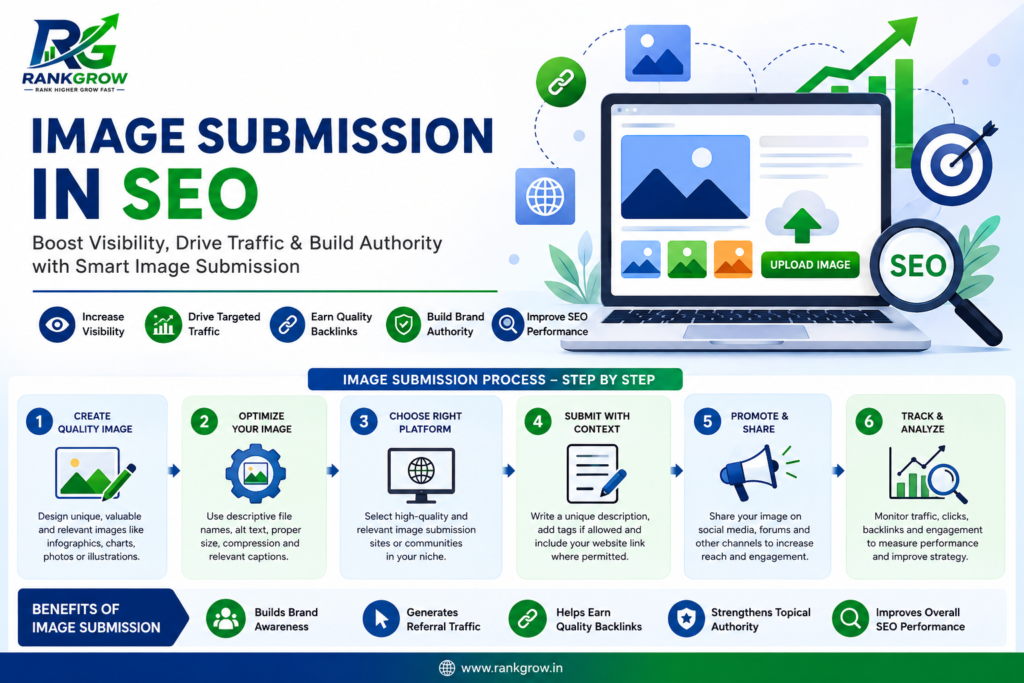
A basic image submission workflow looks like this:
Create → Optimize → Select Platform → Submit → Promote → Monitor
Let’s break it down.
Step 1: Create an Original Image
Start with useful visual content.
Avoid submitting random stock images simply for the purpose of building links.
Instead, create visuals that provide value.
Examples include:
- Original infographic
- SEO checklist
- Comparison chart
- Process diagram
- Tutorial graphic
- Industry statistics
- Original photograph
- Product demonstration
- Data visualization
The more useful the asset, the greater its potential for engagement and natural sharing.
Step 2: Optimize the Image
Before uploading, optimize the file.
Consider:
- File size
- Image dimensions
- Image format
- Filename
- Alt text
- Caption
- Description
- Branding
- Relevance
Google recommends descriptive filenames and useful alt text while warning against keyword stuffing in image alt attributes. (Google for Developers)
For example:
Poor filename:
IMG12345.jpg
Better filename:
image-submission-in-seo-guide.jpg
The second filename provides clearer context.
Step 3: Select Relevant Platforms
Do not submit your image to every platform you can find.
Instead, choose platforms based on:
- Audience relevance
- Content type
- Platform quality
- Editorial standards
- Engagement
- Industry relevance
- Ability to add context
- Whether links are permitted
A marketing infographic should be promoted on platforms where business and marketing audiences are active.
Step 4: Write a Useful Description
Do not copy and paste the same description everywhere.
Write a short, natural description explaining:
- What the image shows
- Why it is useful
- What topic it covers
- Where users can learn more
For example:
This infographic explains the basic image submission process in SEO, including image optimization, platform selection, and common mistakes beginners should avoid.
Step 5: Add Your Website Link Where Appropriate
If the platform allows a website link, use it naturally.
Ideally, link to the page where the image is originally published or where users can find additional information.
Avoid forcing keywords into every link.
Google’s link guidance emphasizes crawlable links and descriptive anchor text that helps users and search engines understand the destination. (Google for Developers)
Step 6: Track Results
After publishing your image, monitor performance.
Look at:
- Referral traffic
- Impressions
- Clicks
- Engagement
- Brand mentions
- Backlinks
- Search visibility
- Image search performance
The goal is to determine which visual content and platforms actually contribute value.
Best Image Submission Sites and Platforms
There is no universal list of “best image submission websites.”
Platform quality changes over time, and a website that was useful several years ago may no longer provide meaningful SEO value.
Instead of chasing a fixed list, think about platform categories.
1. Visual Discovery Platforms
These platforms are designed around discovering visual content.
They can be useful for:
- Infographics
- Tutorials
- Inspiration
- Educational graphics
- Product visuals
2. Image-Sharing Communities
These communities allow users to upload and discover photographs or visual content.
They can be useful for:
- Photography
- Creative work
- Design
- Illustrations
- Original images
3. Social Media Platforms
Visual-first social networks can help distribute:
- Infographics
- Reels thumbnails
- Educational graphics
- Brand images
- Product images
4. Portfolio Platforms
These can be valuable for:
- Graphic designers
- Photographers
- UI/UX designers
- Illustrators
- Creative agencies
5. Industry-Specific Communities
These are often more valuable than generic image-sharing sites.
For example, a technology business may receive more meaningful exposure from a relevant technology community than from a random image directory.
6. Content Communities
Some content platforms allow users to publish visual resources along with descriptions and supporting information.
The important point is to choose quality and relevance instead of submission volume.
How to Optimize Images Before Submission
Image optimization should happen before distribution.
1. Use Descriptive File Names
Use a meaningful filename that describes the image.
For example:
image-submission-seo-guide.jpg
is preferable to:
final-image-new-2.jpg
However, don’t turn filenames into long keyword strings.
2. Write Helpful Alt Text
Alt text helps describe images for users who cannot see them and helps search engines understand the image.
For example:
Bad:
alt="SEO image SEO image submission SEO backlinks SEO"
Better:
alt="Image submission process for off-page SEO"
The second version is clear, natural, and descriptive.
Google specifically recommends useful, information-rich alt text and advises against keyword stuffing. (Google for Developers)
For additional accessibility guidance, see the W3C guidance on alternative text.
3. Compress Images
Large images can increase page load times.
Therefore, compress images while maintaining acceptable visual quality.
Common formats include:
- WebP
- AVIF
- JPEG
- PNG
- SVG
Google’s image SEO documentation lists supported image formats and recommends balancing image quality with page performance. (Google for Developers)
4. Use Responsive Images
Your image should work well on:
- Desktop
- Mobile
- Tablet
Responsive image techniques can help browsers serve appropriate image versions based on the user’s device.
5. Add Captions When Useful
A caption can provide additional context.
For example:
Image: SEO Image Submission Workflow
Caption: A five-step process for creating, optimizing, submitting, and promoting visual content.
Captions are especially helpful for educational images, diagrams, and infographics.
6. Use Relevant Context
Don’t place an image randomly on a page.
If your article discusses image submission, the image should reinforce that topic.
Google states that the content of the page, surrounding text, image titles, filenames, and alt text can all contribute to understanding the subject matter of an image. (Google for Developers)
Image Submission and Backlinks: Does It Really Work?
This is one of the most common questions beginners ask.
Yes, image submission can sometimes support backlink acquisition, but you should not treat every image submission as a guaranteed SEO backlink.
Some platforms may:
- Allow a clickable website link
- Use nofollow or similar link attributes
- Allow profile links
- Allow source attribution
- Remove links
- Prevent external linking entirely
Therefore, the SEO value varies by platform.
More importantly, a link should not be the only reason for publishing an image.
A better approach
Create an original visual that people genuinely want to reference.
For example:
- Publish original SEO research.
- Convert your findings into an infographic.
- Publish the infographic on your website.
- Promote it through relevant visual channels.
- Encourage legitimate attribution.
- Monitor brand mentions and backlinks.
- Build relationships with publishers in your niche.
This approach is more sustainable than mass submission.
Is Image Submission a White-Hat SEO Technique?
Image submission can be a legitimate SEO practice when it is used for genuine content distribution and audience engagement.
However, the way you execute it matters.
Good practices
- Submit original content.
- Use relevant platforms.
- Follow platform rules.
- Provide accurate descriptions.
- Use natural links.
- Focus on user value.
- Avoid automated spam.
- Maintain consistent branding.
Risky practices
- Mass submission to hundreds of unrelated websites
- Using automated submission software
- Creating hundreds of low-quality images
- Keyword stuffing descriptions
- Repeating the same text everywhere
- Using irrelevant backlinks
- Using copyrighted images without permission
Modern SEO is not about manipulating search engines with large quantities of low-quality links.
It is about creating useful content and making it discoverable.
Image Submission for Topical Authority
If you want to build topical authority, image submission should be part of a bigger content ecosystem.
For example, imagine your website targets the SEO industry.
You could build a topic cluster like this:
Pillar Topic: SEO
Supporting topics:
- What is SEO?
- On-page SEO
- Off-page SEO
- Technical SEO
- Local SEO
- Keyword research
- Link building
- Image SEO
- Image submission
- Social bookmarking
- Guest posting
- Content marketing
- Internal linking
- SEO audits
Now create visual assets for each cluster.
Example
Article: What Is Off-Page SEO?
Create:
- Off-page SEO infographic
- Link-building process diagram
- Off-page SEO checklist
Then connect these visuals to relevant articles.
This creates a stronger topical ecosystem.
Semantic Keywords for Image Submission in SEO
To build topical relevance naturally, include related terminology rather than repeatedly using the exact primary keyword.
Useful semantic keywords include:
- image SEO
- image optimization
- image submission sites
- image sharing websites
- visual content marketing
- off-page SEO
- link building
- backlink building
- referral traffic
- image search optimization
- Google Images SEO
- image indexing
- image discoverability
- alt text
- image filename optimization
- image compression
- visual search
- infographic submission
- content promotion
- visual content distribution
- website traffic
- brand visibility
- organic search
- search engine optimization
- image sitemap
- structured data
- content marketing
- topical authority
- SEO strategy
Use these terms where they genuinely help the reader.
Image Submission vs Other Off-Page SEO Techniques
Image submission is only one part of off-page SEO.
| Technique | Main Purpose |
|---|---|
| Image Submission | Visual distribution and discovery |
| Guest Posting | Content exposure and relationship building |
| Social Bookmarking | Content discovery |
| Forum Marketing | Community engagement |
| Digital PR | Brand mentions and authority |
| Linkable Assets | Natural link acquisition |
| Infographic Marketing | Visual content promotion |
| Business Listings | Local visibility |
| Resource Link Building | Earn relevant backlinks |
A successful SEO strategy does not depend on one technique.
Instead, combine multiple relevant strategies according to your website’s goals.
How to Create an Effective Image Submission Strategy
If you’re a beginner, follow this simple framework.
Step 1: Define Your Goal
Ask yourself:
- Do I want referral traffic?
- Do I want brand exposure?
- Do I want to promote an infographic?
- Do I want to earn natural mentions?
- Do I want to distribute visual content?
Your goal determines your strategy.
Step 2: Create Valuable Visual Content
Focus on originality.
Examples:
- Original research
- Statistics
- Checklists
- Tutorials
- Visual guides
- Comparisons
- Charts
Step 3: Optimize the Image
Check:
- Filename
- Alt text
- Dimensions
- File size
- Format
- Branding
- Context
Step 4: Find Relevant Platforms
Prioritize:
Relevance > Quality > Audience > Engagement > Link Opportunity
Do not reverse this order.
Step 5: Publish on Your Website First
Whenever possible, publish the original visual on your website before distributing it elsewhere.
This creates a primary source that other users can reference.
Step 6: Promote the Visual
Share the asset through appropriate channels.
Make each description unique and platform-specific.
Step 7: Measure Results
Track:
- Referral sessions
- Click-through rate
- Engagement
- Mentions
- Backlinks
- Search impressions
- Conversions
Then repeat what works.
Image Sitemaps and Image Submission: Are They the Same?
No.
This distinction is important.
Image submission usually refers to distributing images through external websites or platforms.
An image sitemap is a technical SEO method that helps search engines discover images on your website.
Google explains that image sitemaps can help Google discover images that might otherwise be difficult to find, including images accessed through JavaScript. (Google for Developers)
Therefore:
External image submission = content distribution
Image sitemap = image discovery and crawling support
They serve different purposes.
You can learn more from Google’s official image sitemap documentation.
Image Submission and Google Images SEO
If you want your visual content to appear in Google Images, external image submission alone is not enough.
You should also optimize the original page.
Google recommends:
- Using standard HTML image elements
- Creating descriptive filenames
- Adding useful alt text
- Providing relevant page context
- Using responsive images
- Optimizing image performance
- Using appropriate image formats
- Considering image sitemaps
Google’s Image SEO Best Practices provides the official recommendations.
You should also make sure search engine crawlers can access the page and image.
How Image Submission Supports AI Search and Modern SEO
Search is evolving beyond traditional blue links.
Search engines and AI-powered experiences increasingly depend on content that is understandable, accessible, relevant, and well structured.
Bing’s current webmaster guidelines emphasize clear content, crawlability, authority, and useful multimodal content. They also recommend descriptive filenames and alt text for images. (Search – Microsoft Bing)
This means your visual strategy should not focus solely on backlinks.
Instead, create content that can be understood by:
- Search engines
- Users
- Accessibility tools
- Image search systems
- AI-powered search experiences
That means context matters.
An image should support the written content rather than replace essential information.
Common Image Submission Mistakes to Avoid
1. Submitting to Low-Quality Websites
A large number of submissions does not automatically mean better SEO.
Prioritize quality and relevance.
2. Using Copyrighted Images
Never upload someone else’s image without appropriate permission or licensing.
Whenever possible, create original graphics or use properly licensed assets.
3. Keyword Stuffing
Don’t repeat your target keyword in:
- Filename
- Title
- Description
- Alt text
- Anchor text
Use natural language.
4. Using the Same Description Everywhere
Duplicate descriptions can make your promotional activity look unnatural.
Customize the description for each platform.
5. Focusing Only on Backlinks
A backlink is not the only objective.
Consider:
- Brand visibility
- Referral traffic
- Engagement
- Content discovery
- Audience growth
- Natural mentions
6. Ignoring Image Quality
A blurry infographic or unreadable chart is unlikely to attract engagement.
Make the content visually clear.
7. Creating Images Without a Purpose
Every image should have a reason to exist.
Ask:
Does this image help the user understand something faster?
If the answer is no, reconsider creating it.
Image Submission Checklist for SEO
Before publishing an image, use this checklist:
Image Creation
- Is the image original?
- Is it useful?
- Is it relevant to your niche?
- Does it support a specific topic?
Image Optimization
- Descriptive filename
- Useful alt text
- Optimized file size
- Appropriate image format
- Mobile-friendly dimensions
- Good visual quality
Submission
- Relevant platform selected
- Platform rules reviewed
- Unique description written
- Website link added where appropriate
- Source/credit provided if required
SEO
- Original image published on your website
- Image placed near relevant content
- Internal links added
- Image sitemap considered where relevant
- Performance monitored
Internal Linking Strategy for Your Image Submission Article
Internal linking is important for building topical authority because it helps users and search engines discover related content.
If you’re publishing this article on an SEO-focused website such as RankGrow, consider linking this article to relevant supporting pages.
Suggested internal links
Anchor text: “what is off-page SEO”
Link to: Your article about Off-Page SEO
Anchor text: “what is image SEO”
Link to: Your Image SEO guide
Anchor text: “how to build backlinks”
Link to: Your backlink-building guide
Anchor text: “keyword prominence in SEO”
Link to: Your Keyword Prominence article
Anchor text: “on-page SEO”
Link to: Your On-Page SEO guide
Anchor text: “SEO strategy for beginners”
Link to: Your beginner SEO strategy article
Anchor text: “DA and PA in SEO”
Link to: Your DA and PA guide
The goal is to build a connected content network rather than isolated articles.
Google’s guidance explains that links help Google discover pages and understand relationships between pages, while descriptive anchor text helps users and search engines understand the destination. (Google for Developers)
Six External Authority Resources to Reference
For stronger trust and topical depth, you can naturally reference authoritative resources such as:
- Google Image SEO Best Practices — Useful for image optimization, filenames, alt text, responsive images, and image discovery.
- Google Image Sitemaps Documentation — Useful for understanding image sitemap implementation.
- Google Image Metadata Documentation — Useful for image metadata, licensing information, and structured data.
- Google Link Best Practices — Useful for internal linking, crawlable links, and descriptive anchor text.
- Bing Webmaster Guidelines — Useful for current search optimization, content quality, discovery, and image guidance.
- W3C Alternative Text Guidance — Useful for accessibility and writing appropriate alternative text.
These sources are preferable to linking repeatedly to random SEO blogs because they provide primary or recognized authority guidance.
Frequently Asked Questions About Image Submission in SEO
What is image submission in SEO?
Image submission in SEO is the practice of distributing relevant and optimized images through appropriate external platforms to improve visual content discovery, brand exposure, referral traffic, and opportunities for natural mentions or links.
Is image submission an off-page SEO technique?
Yes. When you publish or promote images on third-party websites, image submission is generally considered an off-page SEO or content promotion activity.
However, image optimization on your own website is primarily an on-page and technical SEO activity.
Does image submission create backlinks?
It can, depending on the platform. Some platforms may provide links, while others may use nofollow attributes or restrict external links. Therefore, don’t depend on image submission solely for backlinks.
Is image submission still useful for SEO?
Yes, when used strategically. Its value is strongest when image submission is treated as visual content distribution rather than mass backlink creation.
How many image submission websites should I use?
There is no ideal number.
Quality and relevance are more important than quantity. Start with a small number of relevant platforms and monitor the results.
Can image submission improve website traffic?
It can generate referral traffic when users discover your visual content and click through to your website.
Traffic potential depends on platform quality, audience relevance, content quality, and engagement.
Should I submit the same image everywhere?
You can distribute the same core visual, but avoid blindly duplicating descriptions and metadata across every platform.
Customize your presentation for the audience and format of each platform.
What images are best for submission?
Useful visual assets include:
- Infographics
- Original photographs
- Charts
- Data visualizations
- Tutorials
- Checklists
- Diagrams
- Illustrations
- Educational graphics
Is alt text important for image SEO?
Yes. Alt text helps describe images to users who cannot see them and provides search engines with contextual information. It should be descriptive and natural rather than stuffed with keywords. (Google for Developers)
What is the difference between image submission and infographic submission?
Image submission is a broader category that can include photographs, graphics, illustrations, product images, and other visual assets.
Infographic submission specifically focuses on distributing infographic-style visual content.
Can image submission help build topical authority?
Indirectly, yes. When visual assets support a well-organized collection of high-quality articles around a specific subject, they can strengthen your overall content ecosystem and improve content distribution.
However, topical authority comes primarily from comprehensive, useful, trustworthy content—not from image submissions alone.
Is image submission better than guest posting?
Neither is universally better.
Guest posting and image submission have different purposes. Guest posting can support content exposure and relationships, while image submission focuses on visual content distribution.
A balanced off-page SEO strategy can use both where appropriate.
Final Thoughts: Is Image Submission Worth Doing in SEO?
Image submission in SEO is useful when it is approached as a content distribution and brand visibility strategy rather than a shortcut for generating backlinks.
The biggest mistake beginners make is focusing on quantity.
Submitting one image to 500 irrelevant websites is unlikely to create the same value as creating one genuinely useful infographic and promoting it through a handful of highly relevant channels.
The modern approach is simple:
Create valuable visuals → Optimize them → Publish on your website → Distribute strategically → Build relationships → Monitor results.
Also remember that image submission should work together with other SEO activities.
Your broader strategy should include:
- Keyword research
- Search intent optimization
- Helpful content
- On-page SEO
- Technical SEO
- Internal linking
- Image SEO
- Content promotion
- Digital PR
- Relevant link building
- Topical authority development
If you’re building an SEO-focused website, don’t create this article as a standalone page. Use it as part of an Image SEO + Off-Page SEO topical cluster.
For example:
SEO → Off-Page SEO → Image Submission → Image SEO → Infographic Marketing → Link Building → Content Promotion
Then connect these pages through strategic internal links.
That approach gives users multiple ways to explore your website while creating a stronger topical structure.
Ready to Build Your SEO Authority?
If you want to grow your website’s organic visibility, start by creating one valuable visual asset around a topic your audience genuinely wants to understand.
Optimize it properly, publish it on your website, promote it on relevant platforms, and connect it with your supporting SEO content.
Don’t chase hundreds of low-quality submissions. Build useful visual content that deserves to be discovered, shared, referenced, and linked to.
That is the sustainable way to make image submission part of a modern SEO strategy.
This article is structured to support a broader topical authority cluster around SEO, off-page SEO, image SEO, link building, and content promotion. For your RankGrow site, I’d recommend creating the supporting cluster pages next and interlinking them systematically.

Shivam Pandey is an SEO Specialist and Digital Marketing professional passionate about helping businesses improve their online visibility. He shares practical insights on SEO, content marketing, digital marketing strategies, and the latest industry trends to help marketers and businesses grow online.