

Keyword prominence is a part of on page Seo page search where keywords are displayed in prominent places on web pages for better understanding by Google.
If you have ever wondered why two pages targeting the same phrase rank differently, keyword placement is often part of the answer.
In this guide, you will learn what keyword prominence in SEO means, how it affects search visibility, and how to use it naturally without over-optimizing your content. Learn more about SEO – Search Engine Optimization Presentation 2026
Table of Contents
What Is Keyword Prominence in SEO?
Keyword prominence refers to how often and how clearly it appears in prominent areas of a webpage.
In simple terms, Google pays more attention when your primary keyword appears in places such as:
- The page title
- The first paragraph
- Headings
- Meta description
- URL
- Image alt text
For example, if your target phrase is “keyword prominence in SEO,” a title like:
“Keyword Prominence in SEO: Complete Beginner’s Guide”
is generally stronger than:
“A Beginner’s Guide to Understanding Search Rankings and Keyword Placement”
Both titles discuss the topic, but the first clearly signals relevance immediately.
This concept is part of broader seo ranking factors connected to content relevance and page structure.
Why Keyword Prominence Matters in Modern SEO?
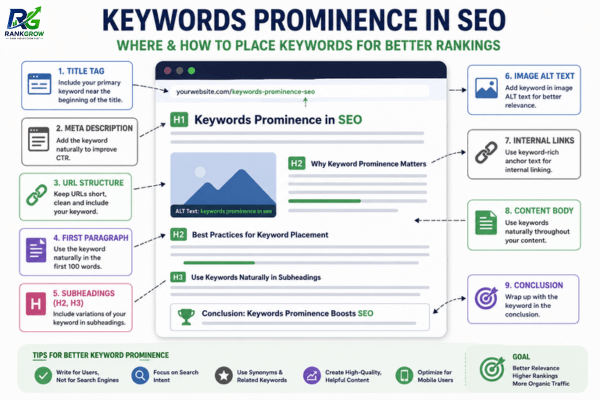
Google’s algorithms and SEO have changed since the introduction of semantic SEO, making the algorithms smarter, but Google still needs signals to understand search engine pages.
According to Google Search Central, helpful content should make page topics clear to both users and search engines.
Keyword prominence helps by:
- Improving topical clarity
- Strengthening content relevance
- Supporting better indexing
- Enhancing user experience
- Reinforcing search intent alignment
Keyword Prominence vs Keyword Density
One of the biggest misconceptions in search engine optimization keywords strategy is confusing keyword prominence with keyword density.
Keyword Density
Keyword density measures how many times a keyword is repeated within a school number. This depends on the website’s pages and their services.
For example:
- 10 mentions in a 1000-word article = 1% density
Years ago, marketers often stuffed pages with repeated phrases hoping to manipulate rankings. Google now discourages this practice.
Keyword Prominence
Keyword prominence focuses on placement, not repetition. .Keyword prominence is displayed at a prominent place on the website so that Google can easily understand it.
A keyword appearing naturally in:
- the title,
- introduction,
- and headings
usually matters more than repeating it 25 times throughout a page.
Keyword Density vs Keyword Prominence: Which Matters More?
Today, prominence is generally more important than density.
Google’s systems are advanced enough to understand:
- synonyms,
- related phrases,
- topic relationships,
- and user intent.
That is where semantic SEO becomes important.
Instead of forcing the exact phrase repeatedly, strong content naturally includes related terms like:
- keyword optimization,
- seo ranking,
- google ranking,
- and keyword proximity in SEO.
This creates a more natural reading experience while improving topical authority.
Where to Place Keywords for Better SEO Ranking
Strategic keyword placement remains one of the most practical on page SEO techniques.Strategic keyword placement is a key part of the page, allowing Google to easily understand the structure of the website.and Google is able to deliver the correct information to the user.
Here are the most important areas.
1. Title Tag
The title tag represents the keywords of the page, which helps the user understand the services of the website.
Example:
Search Engine Optimization Presentation: Best Practices for Higher Rankings
2. First 100 Words
Google page ko jaldi samjhne ke liye introduction ka upyog karta hai kyuki hamara main keyword include hota hai or user easily hamare page ki quality ko samjh pata hai
For example, this article introduced “keyword prominence in SEO” immediately because it establishes topical focus early.
3. H1 and H2 Headings
Headings help organize information for readers and search engines.
Using keywords in headings can:
- improve readability,
- strengthen topical relevance,
- and help featured snippet visibility.
However, every heading should still sound human.
Bad example:
SEO Ranking Keyword Optimization Keyword Placement
Better example:
How Keyword Placement Influences SEO Ranking
4. URL Structure
Simple URLs improve usability ,Crawling and indexing.
Good URL:
yoursite.com/keyword-prominence-seo
Poor URL:
yoursite.com/article-2026-seo-topic-page-final-version
Short, descriptive URLs work better for both users and search engines.
5. Meta Description
Meta description is a short summary of your entire page which the user reads and visits the page.
according to Google Search Central Documentation.
However, they can improve click-through rates.
Including the target keyword naturally may help Google bold matching search terms in results.
Understanding Keyword Proximity in SEO
Another closely related concept is keyword proximity in SEO.
Keyword proximity refers to how closely related words appear together within content.
For example:
“Keyword prominence improves SEO ranking.”
is generally more contextually connected than:
“Keyword prominence sometimes affects many technical aspects of modern website SEO ranking strategies.”
Closer relationships between important terms can strengthen contextual understanding.
Still, modern Google algorithms prioritize natural writing over rigid keyword formulas.
Do not force phrases unnaturally just to keep words close together.
How Semantic SEO Changed Keyword Optimization
Google’s algorithms now evaluate:
- topic depth content ,
- search intent,
- entity relationships,
- and semantic relevance.
This shift made semantic SEO a critical part of content strategy.
For example, an article about keyword prominence may also naturally mention:
- on page SEO techniques,
- content optimization,
- search engine optimization keywords,
- and google ranking factors.
These related concepts help search engines understand the broader topic.
Google’s helpful content systems reward pages that demonstrate expertise and comprehensive topic coverage rather than mechanical keyword repetition.
Common Keyword Prominence Mistakes
Even experienced marketers sometimes misuse keyword optimization strategies.
Here are common mistakes to avoid.
Keyword Stuffing
Repeating keywords excessively hurts readability and may trigger spam signals.
Bad example:
“Keyword prominence in SEO improves SEO ranking because keyword prominence helps keyword optimization.”
That sentence sounds robotic.
Forced Heading Optimization
Some websites overload headings with repetitive keywords.
This damages user experience and reduces content quality.
Headings should guide readers first.
Ignoring Search Intent
Ranking is not just about keywords anymore.
Google evaluates whether your content actually satisfies the user’s query.
For example:
- informational searches need educational content,
- transactional searches need product-focused pages,
- navigational searches need direct answers.
Keyword placement alone cannot compensate for poor intent matching.
Writing Only for Search Engines
Some content creators still write pages designed entirely around algorithms.
Ironically, Google’s systems increasingly reward content written primarily for humans.
According to Google Helpful Content Guidelines, content should demonstrate expertise, experience, and usefulness.
That means:
- clear explanations,
- logical structure,
- trustworthy sources,
- and authentic value.
Best Practices for Natural Keyword Optimization
The safest and most effective SEO strategy is balanced optimization.
Here are practical best practices.
Focus on One Primary Topic
Each page should target a clear central topic.
Trying to rank one article for 20 unrelated keywords usually weakens topical focus.
Use Related Terms Naturally
Search engines understand context better than ever.
Instead of repeating one exact phrase, use:
- synonyms,
- semantic variations,
- and contextual language.
This improves readability while strengthening topical authority.
Prioritize Readability
Good SEO writing is easy to scan.
Use:
- short paragraphs,
- descriptive headings,
- bullet points,
- and conversational explanations.
Readers stay longer on pages that feel approachable.
Optimize Important Areas First
Do not obsess over keyword percentages.
Instead, prioritize:
- Title tag
- Introduction
- Headings
- URL
- Meta description
These areas carry the strongest relevance signals.
Write for Humans First
This advice may sound cliché, but it remains true.
The best-performing content usually:
- answers questions clearly,
- avoids fluff,
- demonstrates expertise,
- and feels genuinely useful.
Search engines increasingly reward human-centered content experiences.
Does Keyword Prominence Still Matter in 2026?
Yes — but not in the old-fashioned, spammy way.
Today, keyword prominence works best when combined with:
- semantic SEO,
- strong user intent alignment,
- topical authority,
- and helpful content practices.
Google ranking systems are sophisticated, but they still rely on clear topical signals.
Strategic keyword placement helps search engines understand your page quickly while improving reader clarity.
The key is balance.
Use keywords naturally where they make sense, avoid over-optimization, and focus on delivering real value.
That approach supports both search visibility and long-term credibility.
Final Thoughts
Keyword prominence in SEO remains an important part of modern on page SEO techniques. While keyword density has become less critical, strategic placement still helps search engines identify page relevance efficiently.
The most successful SEO content today combines:
- natural keyword optimization,
- semantic SEO principles,
- clear structure,
- and genuinely useful information.
- Show users the most helpful result.
We should create attractive content for our website or blog so that the user can get a correct guidance and Google gives first priority to our content because Google gives preference only to original content.
FAQ
What is keyword prominence in SEO?
Keyword prominence in SEO refers to how early and how visibly your target keyword appears within a page’s key elements — such as the title tag, first paragraph, headings, and meta description. Search engines like Google place higher value on keywords that appear near the beginning of important content areas, making prominence a critical on-page SEO factor.
Why does keyword prominence matter for Google ranking?
Google uses keyword placement signals to understand what your page is about. When your primary keyword appears prominently — especially in the title tag, H1 heading, and first 100 words — it sends a strong relevance signal to crawlers. This can positively impact your Google ranking by confirming that the page directly addresses a searcher’s query.
What is the difference between keyword prominence and keyword density?
Keyword prominence focuses on where your keyword appears on a page — earlier is generally better. Keyword density measures how often the keyword appears relative to the total word count. Both are SEO ranking factors, but keyword prominence is widely considered more impactful than simply repeating a keyword many times throughout the content.
Where should I place keywords for maximum SEO impact?
For strong keyword placement, include your target keyword in the page title (H1), the first paragraph, at least one subheading (H2 or H3), the meta description, and the URL slug when possible. These positions carry the most weight in on-page SEO. Avoid forcing keywords unnaturally — readability and user experience always come first.
How close to the beginning of my content should the main keyword appear?
Best practice in search engine optimization is to include your primary keyword within the first 100 words of your content — ideally in the very first sentence or paragraph. The closer the keyword is to the start of the page body, the stronger the prominence signal sent to search engines, improving your chances of higher Google ranking.
Does keyword prominence affect featured snippet chances?
Yes — keyword prominence plays an important role in winning Google featured snippets. Structuring your content with the keyword in a clear question or definition format, placed near the top of the relevant section, helps Google identify your page as a strong featured snippet candidate. Concise, well-structured answers of 40–60 words work best.
What is keyword proximity and how is it different from keyword prominence?
Keyword proximity refers to how close two or more related keywords are to each other within your content. Keyword prominence, on the other hand, relates to where a single keyword appears on the page. Both are on-page SEO signals, but proximity is especially important for multi-word phrases and helps search engines understand topic context.
How does semantic SEO relate to keyword prominence?
Semantic SEO expands keyword prominence beyond exact-match terms to include related concepts, synonyms, and topic clusters. Instead of repeating one keyword, you place semantically related terms prominently throughout key page sections. This approach helps search engines understand the full context of your content and aligns with how modern Google ranking algorithms interpret meaning.
Should I include the keyword in the H1 tag?
Absolutely. The H1 tag is one of the highest-priority on-page SEO elements. Including your primary keyword — ideally at or near the start of your H1 — maximizes keyword prominence and clearly communicates your page’s topic to both users and search engine crawlers. Every page should have exactly one H1 that contains the main keyword.
Does keyword prominence in the meta description help SEO rankings?
Meta descriptions are not a direct Google ranking factor, but keyword prominence within them matters for click-through rates. When users search for a term and see it in your meta description, it appears bold in search results, increasing the likelihood of clicks. More clicks signal relevance to Google, which can indirectly support your rankings over time.
Can over-optimizing keyword prominence hurt my SEO?
Yes. Forcing your keyword unnaturally into the very start of every section can make content read poorly and trigger keyword stuffing penalties. Search engine optimization is about balance — prioritize user experience first. Place your primary keyword prominently where it fits naturally, then use related terms and synonyms to reinforce relevance throughout the rest of the page.
Is keyword prominence important for voice search SEO?
Yes — voice search queries are often phrased as full questions, and devices look for concise, prominent answers near the top of content. Placing your keyword and a direct answer within the first paragraph or under a clearly labeled heading significantly improves your chances of being the voice search result. This ties closely to featured snippet optimization as well.
How does keyword prominence work in image alt text?
Search engines cannot see images, so they rely on alt text to understand visual content. Including your primary keyword naturally in the alt attributes of relevant images adds another layer of keyword prominence without disrupting the reading experience. Keep alt text descriptive and concise — it should accurately describe the image while incorporating the keyword where logical.
Does the URL structure affect keyword prominence for SEO?
Yes. A clean, keyword-rich URL slug is an important on-page SEO signal. Including your primary keyword in the URL tells both users and search engines exactly what the page is about before they even read the content. Keep URLs short, lowercase, and hyphen-separated, and place the keyword near the beginning of the slug for maximum prominence.

Shivam Pandey is an SEO Specialist and Digital Marketing professional passionate about helping businesses improve their online visibility. He shares practical insights on SEO, content marketing, digital marketing strategies, and the latest industry trends to help marketers and businesses grow online.